Table of contents
Open Table of contents
Introduction
What is an auxiliary tree?
An auxiliary tree (also known as a virtual tree) is a technique for solving a class of problems that query a subset of the vertices of a given tree.
A normal tree query problem asks one question about the whole tree, and techniques such as centroid decomposition, tree dynamic programming, or DSU on tree answer it. Now keep the question but split it into queries, where each query asks only about a given set of vertices. This technique builds a smaller tree from the vertices in the query plus a few extra ones, which is the same as dropping the vertices that the query does not need. You then solve that smaller tree the same way you solved the whole one.
Here is the auxiliary tree built from an original tree:
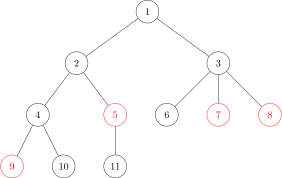
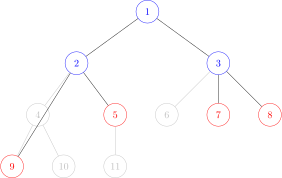
The red vertices are the query vertices, and the blue ones are the vertices that the technique adds.
Prerequisites
To follow this article, you need to know:
- Trees and the basic traversals (DFS, BFS).
- Lowest common ancestor (LCA).
The problem
Look at this simple problem first:
Problem: you have a tree with vertices . Compute the sum of the distances of every pair of vertices in the tree. That is, compute:
where is the distance between the vertices and .
This is a familiar problem, and a DFS answers it. Here is a harder version:
Harder version: there are queries. Query gives vertices, where the sum of all does not exceed , and asks for the sum of the distances of every pair among those vertices.
With many queries you cannot run a DFS over the whole tree for each one. The important constraint is that the sum of stays at most . So if each query can drop the vertices it does not need and shrink the tree, the problem is solved.
Sample implementation
Preprocessing
First run a DFS on the original tree to record the visit order and to find the parent of each vertex.
Notation:
tin[u]: the visit order of vertex in the DFS.anc[j][i]: a sparse table that holds the -th ancestor of vertex .adj[u]: the vertices adjacent to in the original tree.tout[u]: the visit order of the last child in the subtree rooted at .depth[u]: the depth of vertex .
void dfs(int u, int prev = -1) {
    tin[u] = timer++;
    anc[0][u] = prev;
    for (int v : adj[u]) {
        if (v != prev) {
            depth[v] = depth[u] + 1;
            dfs(v, u);
        }
    }
    tout[u] = timer - 1;
}

void preprocess() {
    dfs(0);
    for (int j = 1; j < LOG; ++j) {
        for (int i = 0; i < n; ++i) {
            anc[j][i] = (anc[j - 1][i] != -1 ? anc[j - 1][anc[j - 1][i]] : -1);
        }
    }
}