
Skip to content
Minh-Thien Nguyen

I am an AI researcher working on language models, reasoning, and deep learning. My research interests include inference-time scaling, symbolic reasoning, high-performance model serving, embedding models, Vietnamese image-text retrieval, and retrieval-augmented generation. My work centers on inference-time scaling and neuro-symbolic reasoning, alongside serving large models efficiently enough to be practical.

My papers cover a foundation vision-language model for Vietnamese image-text retrieval, model soups for image classification, and explainable educational question answering. On the engineering side, I have built personal projects on distributed and TPU training and on retrieval-augmented question answering over dense technical documents.

I also have a background in competitive programming. I wrote two articles for VNOI Magazine, on virtual trees (2024) and on XOR techniques (2023), and set and tested problems for the CICT Collegiate Programming Contest and for Can Tho University’s selection contests for the Vietnam Student Olympiad in Informatics.

News

  1. Submitted the CoTu system paper to the EXACT Competition Track at the CSoNet 2026 special session, hosted at HCMUT.

  2. Final results announced for EXACT 2026 at IEEE IJCNN 2026. Team CoTu took the highest technical score of any team, 13.44/15, and placed 3rd overall.

  3. Preprint on model soups for Mekong Delta intangible-cultural-heritage image classification. Early accept at the Journal on Information Technologies and Communications.

  4. Preprint of ViCLIP-OT, a foundation vision-language model for Vietnamese image-text retrieval.

Publications

Preprints and journal papers. Author lists are as submitted.

CoTu at EXACT 2026: Neuro-Symbolic Reasoning for Transparent Educational QA

Quoc-Khang Tran*, Minh-Thien Nguyen*, Phu-An Thai, Xuan-Tung Bui, Truong-Thanh Ma, Nguyen-Khang Pham

Under review at CSoNet 2026, Springer LNCS ·

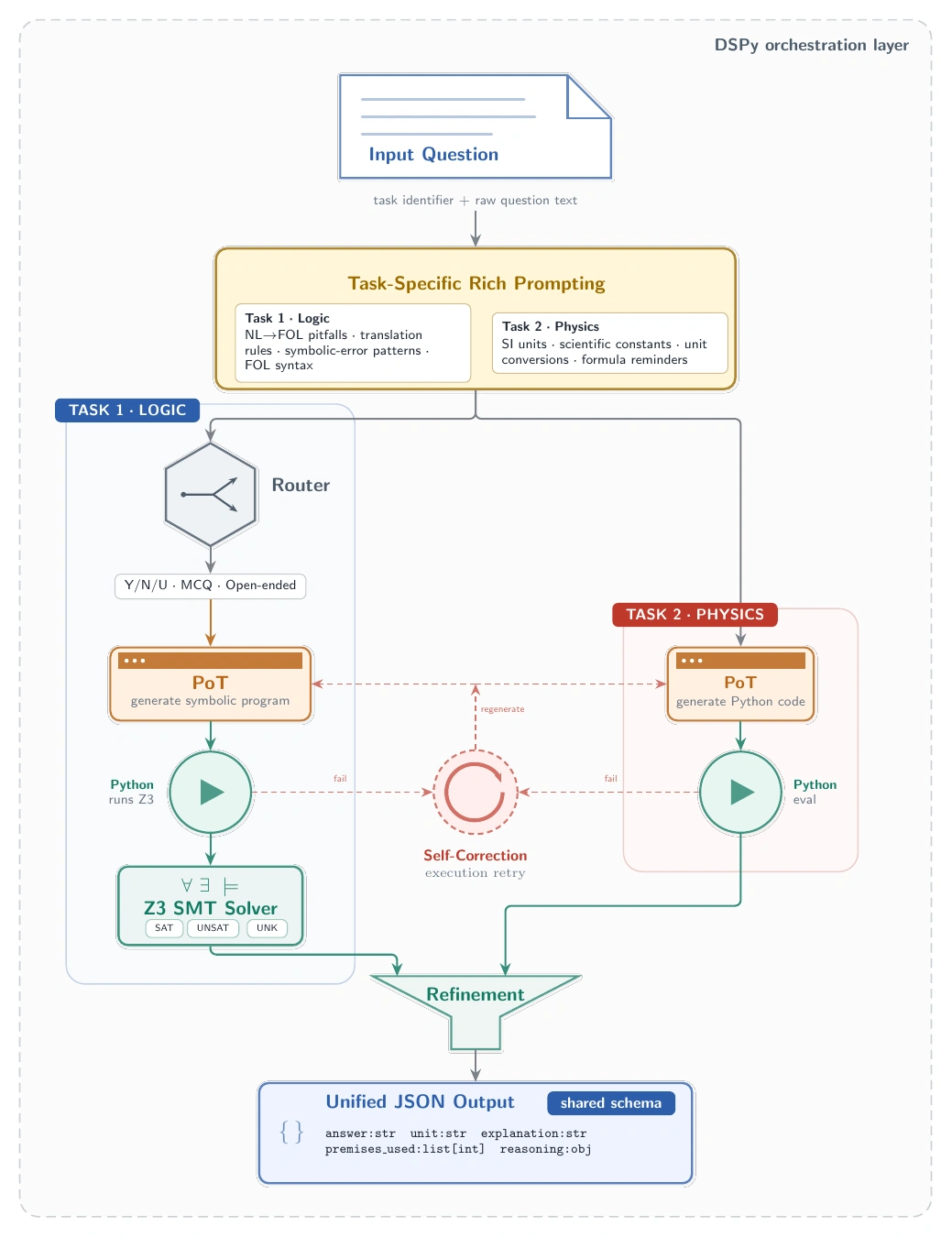
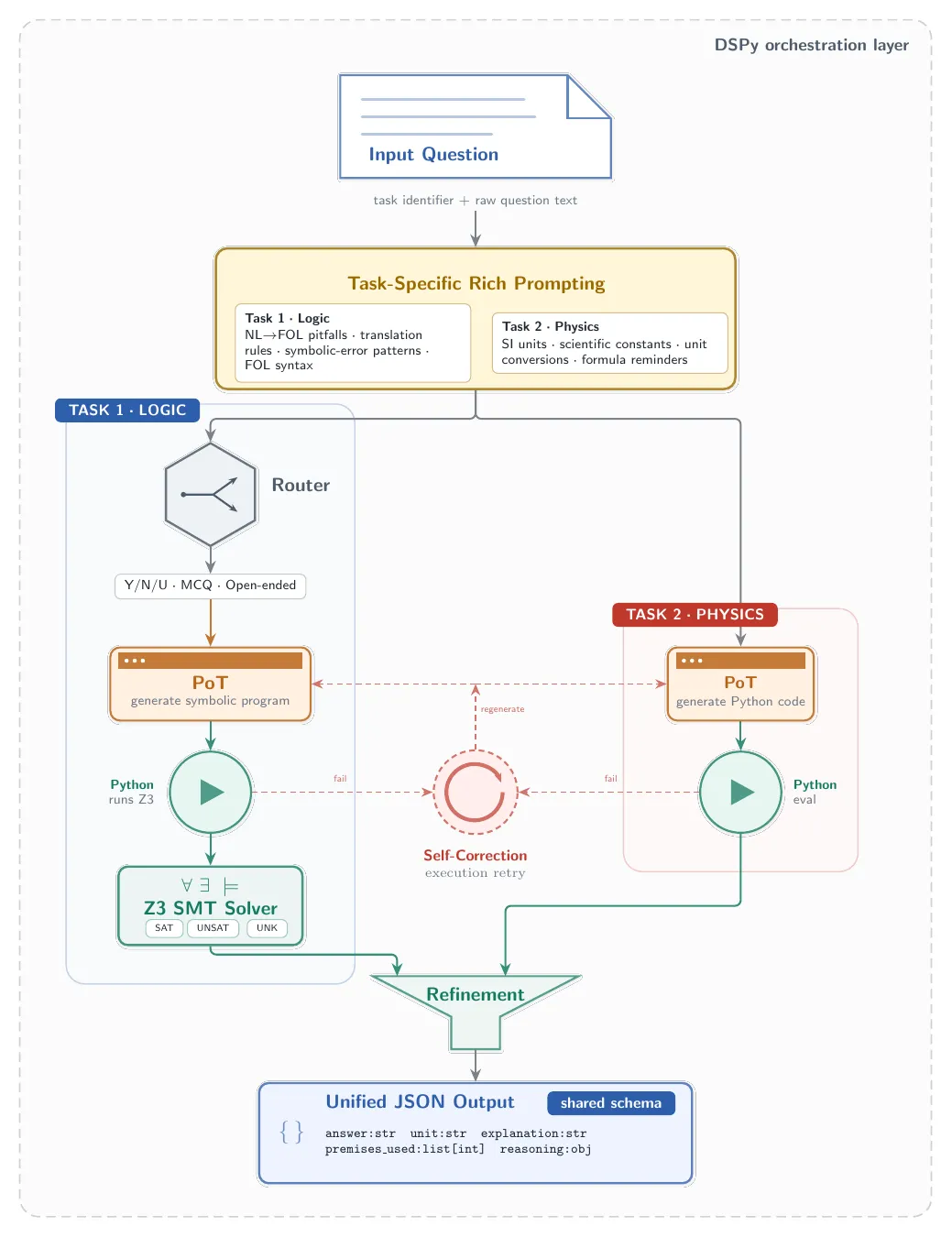
CoTu is a neuro-symbolic Program-of-Thought system for explainable educational question answering. A 4B open-weight backbone writes a program instead of stating an answer: regulation queries become a Z3 encoding whose entailment verdict grounds the deduction, and physics becomes numerical Python. It scored perfectly on physics in both automated selection rounds of the EXACT 2026 challenge and took the highest technical score of any team in the final.

CiteCoTu at EXACT 2026
@misc{tran2026cotu,
  title        = {CoTu at EXACT 2026: Neuro-Symbolic Reasoning for Transparent Educational QA},
  author       = {Tran, Quoc-Khang and Nguyen, Minh-Thien and Thai, Phu-An and Bui, Xuan-Tung and Ma, Truong-Thanh and Pham, Nguyen-Khang},
  year         = {2026},
  eprint       = {2607.14735},
  archivePrefix = {arXiv},
  primaryClass = {cs.CL},
  url          = {https://arxiv.org/abs/2607.14735}
}
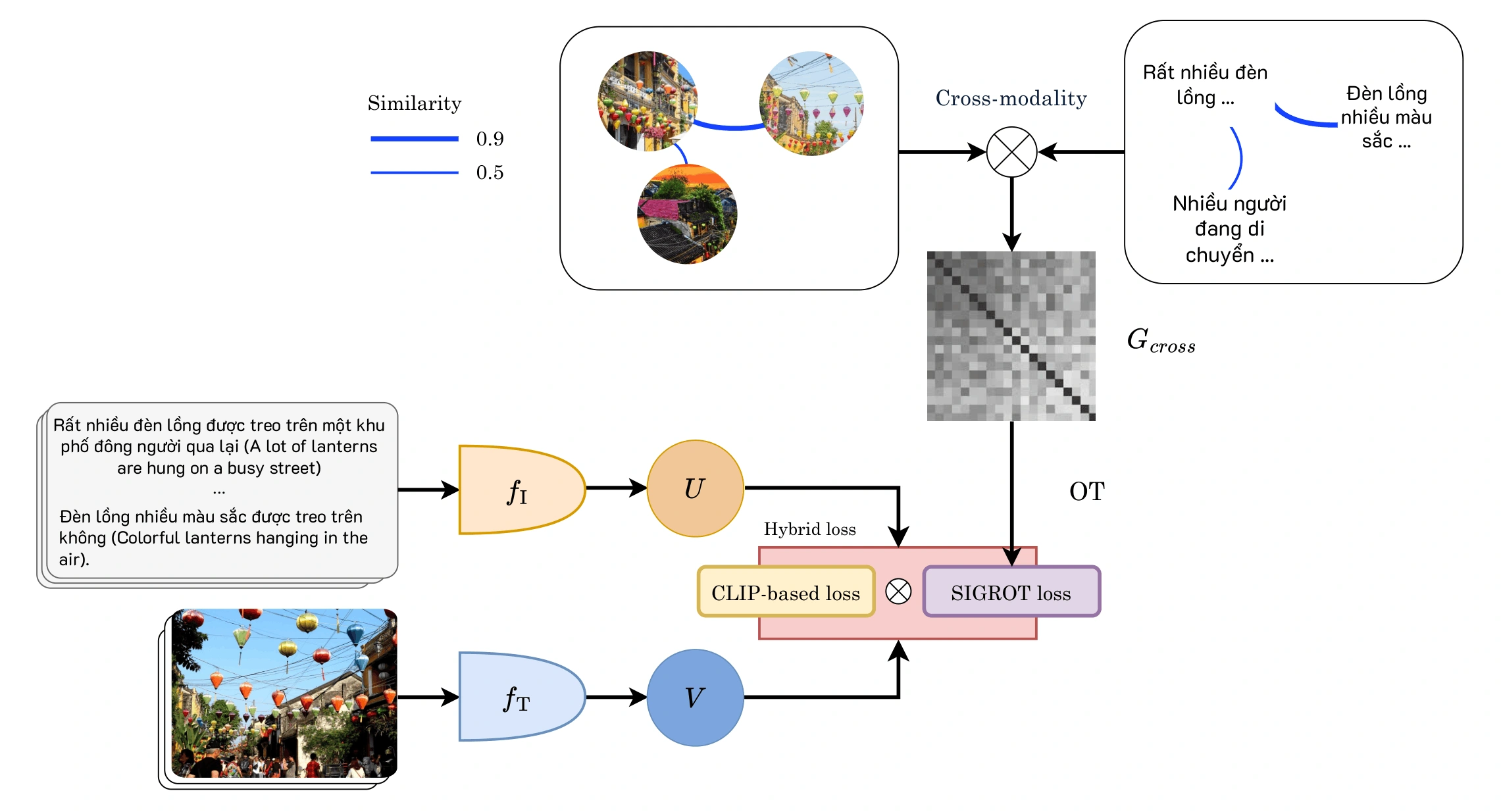
ViCLIP-OT: The First Foundation Vision-Language Model for Vietnamese Image-Text Retrieval with Optimal Transport

Quoc-Khang Tran*, Minh-Thien Nguyen*, Nguyen-Khang Pham

Under review at The Visual Computer ·

A foundation vision-language model for Vietnamese image-text retrieval. It pairs CLIP-style contrastive learning with a Similarity-Graph Regularized Optimal Transport (SIGROT) loss to improve cross-modal consistency and reduce the modality gap.

CiteViCLIP-OT
@misc{tran2026viclipot,
  title        = {ViCLIP-OT: The First Foundation Vision-Language Model for Vietnamese Image-Text Retrieval with Optimal Transport},
  author       = {Tran, Quoc-Khang and Nguyen, Minh-Thien and Pham, Nguyen-Khang},
  year         = {2026},
  eprint       = {2602.22678},
  archivePrefix = {arXiv},
  primaryClass = {cs.CV},
  url          = {https://arxiv.org/abs/2602.22678}
}

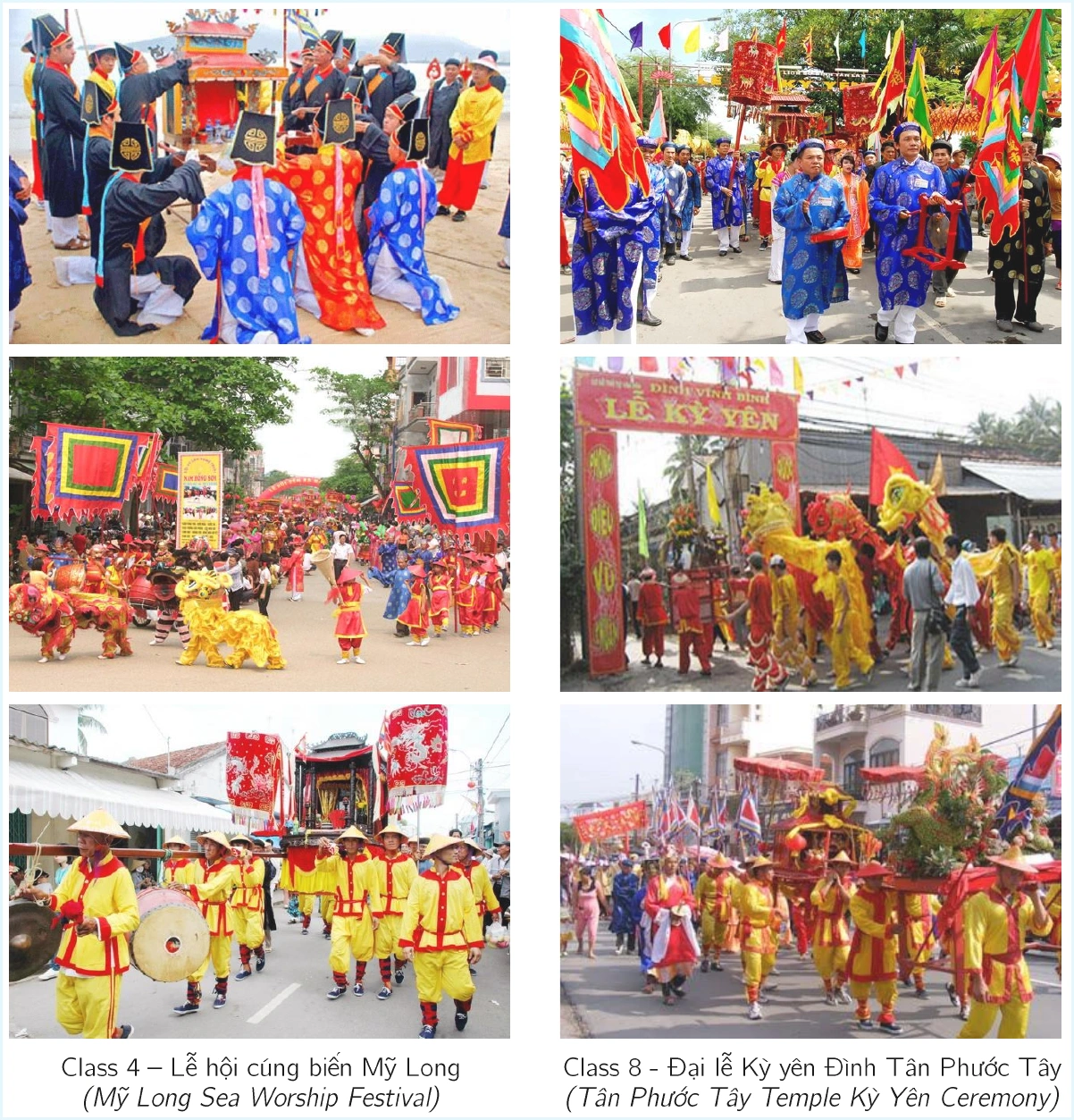
Leveraging Model Soups to Classify Intangible Cultural Heritage Images from the Mekong Delta

Quoc-Khang Tran, Minh-Thien Nguyen, Nguyen-Khang Pham

Journal on Information Technologies and Communications, Vol. 2025 No. 3 ·

A framework that combines the hybrid CoAtNet architecture with model soups, a weight-space ensembling technique that averages checkpoints from one training run without raising inference cost. The paper analyses the effect through bias-variance decomposition.

CiteModel Soups for ICH Classification
@article{tran2026soups,
  title   = {Leveraging Model Soups to Classify Intangible Cultural Heritage Images from the Mekong Delta},
  author  = {Tran, Quoc-Khang and Nguyen, Minh-Thien and Pham, Nguyen-Khang},
  journal = {Journal on Information Technologies and Communications},
  volume  = {2025},
  number  = {3},
  year    = {2026},
  doi     = {10.32913/mic-ict-research.v2025.n3.1395},
  url     = {https://arxiv.org/abs/2603.02181}
}

* Equal contribution.

Experience

  1. AI Researcher

    Independent Research · In collaboration with CICT, Can Tho University

    08/2025 – present

    • Research inference-time scaling, embedding models, Vietnamese image–text retrieval, and optimal transport: set the research questions, design and run the experiments, and write the papers.
    • Three papers to date: one published (ICT Research), two under review (The Visual Computer, CSoNet 2026), plus a 3rd-place finish of 50 teams at the EXACT 2026 challenge.
  2. Data Science and AI Intern

    Viettel AI · Viettel Digital Talent 2026 program

    05/2026 – 08/2026

    • Built ViREx-Bench, an inference-time-scaling evaluation framework supporting 7 reasoning strategies on any OpenAI-compatible model; benchmarked against 8 models.
    • Curated a 294-item Vietnamese multi-step logical-reasoning dataset, translated with TranslateGemma-27B and re-annotated via a program-of-thought + Z3 pipeline (96.7% agreement with human labels).
    • Found chain-of-thought captures most of the accuracy gain; the proposed symbolic-reasoning pipeline (program-of-thought + Z3) led the search-based strategies in accuracy at 3.3 model calls per item, versus 18–28 for the search-based ones.
  3. AI Engineer

    CT Group Corporation

    06/2025 – 08/2025

    • Selected through a competitive talent program run jointly by CT Group Corporation and Can Tho University.
    • Evaluated LLMs (ChatGPT, Grok, Gemini) and AI agent frameworks (ManusAI, OpenManus, AgenticSeek) for integration into existing systems.
    • Built a RAG chatbot with FastAPI and Qdrant that reviews candidate profiles and recommends interview departments.
  4. AI Engineer Intern

    TMA Solutions

    12/2024 – 04/2025

    • Researched 3D human-body modeling and facial-expression-analysis methods to set the project's technical approach.
    • Built a model that generates a 3D human body from a user's height and weight, using SMPL and SMPL-X with Open3D for parameter computation and rendering.
    • Built a facial-expression-analysis module for an AI system that supports autistic children.

Awards

  • 2024

    3rd prize, Vietnam Student Olympiad in Informatics (Super Cup division)

  • 2023

    3rd prize, ICPC Vietnam National Programming Contest

  • 2022

    2nd prize, Vietnam Student Olympiad in Informatics (Specialized Informatics division)

    3rd prize, ICPC Vietnam National Programming Contest

  • 2021

    3rd prize, Vietnam Student Olympiad in Informatics (Non-specialized Informatics division)

Education

Engineer's degree, Information Technology, Can Tho University · GPA 3.91/4.0 · TOEIC 845

Thesis: Building a Smart Enrollment Advisory System Based on an Automatic Dialogue Model · grade 9.6/10

Competitions

EXACT 2026, IEEE IJCNN 2026 Competition ·

2nd International XAI Challenge for Transparent Educational Question-Answering

Highest technical score, 3rd overall

A neuro-symbolic Program-of-Thought pipeline for explainable educational QA under an 8B open-weight limit. Team CoTu took the highest final-round technical score of any team, 13.44/15, and placed 3rd overall once the equally weighted presentation score was included.

EXACT 2026 asks for answers that are correct and explainable, from self-hosted open-weight models capped at 8B parameters with a 60-second budget per query, over two tasks: logical reasoning over university regulations, and multi-step physics. The CoTu system writes a program instead of stating an answer, so regulation queries become a Z3 encoding whose entailment verdict grounds the deduction and physics becomes numerical Python, both sharing a self-correction loop and the same explained-JSON structure. Answer-type routing, distillation-based task fine-tuning, and SGLang with speculative decoding keep it inside the latency limit, and the system scored perfectly on physics in both automated selection rounds. Grounding answers in a symbolic solver produces verifiable deductions even at 4B scale; what remains hard is premise selection, not the deduction itself.

Pipeline of the CoTu system. A 4B backbone routes each question by answer type, then emits either a Z3 encoding for regulation queries or numerical Python for physics, both passing through a shared self-correction loop to a unified explained-JSON output.

Viettel AI Race 2025 ·

Multiple-Choice Question Answering Pipeline for Complex Technical Documents

Top 3 on the public leaderboard

An MCQA pipeline that answers questions over dense technical documentation, where the answer usually depends on retrieving the right passage rather than on reasoning once it is found. A multimodal extraction layer with hybrid dense and sparse retrieval placed top 5 in round 1 and top 3 in rounds 2–3 of the public leaderboard, answering 91.2% of round-3 questions correctly.

Projects

What each project does, and the result it produced.

ViREx-Bench

An evaluation framework for inference-time scaling on Vietnamese reasoning. It supports 7 reasoning strategies on any OpenAI-compatible model and was benchmarked against 8 models, from chain-of-thought and self-consistency to tree-of-thought and the proposed symbolic-reasoning pipeline (program-of-thought + Z3). Search-based methods spend up to 32× more tokens without beating plain chain-of-thought; the proposed pipeline led them in accuracy at 3.3 model calls per item, versus 18–28 for the others.

  • Python
  • Inference-time scaling
  • Evaluation

seas

A RAG chatbot that answers enrollment questions for Can Tho University, built with LangChain and Qdrant on an async FastAPI backend. Comparing retrieval strategies showed reranking drove most of the gain: MRR@10 rose from 0.18 to 0.70, so the final system paired reranking with query expansion.

  • Python
  • FastAPI
  • SQLAlchemy
  • Qdrant

medical-llama2

Med-Alpaca-2-7b-chat, a medical question-answering chatbot fine-tuned from LLaMA 2 7B with QLoRA. Training ran distributed across GPUs; the model was then quantized and served through llama.cpp, with a live demo on Hugging Face Spaces.

  • Python
  • PyTorch
  • LLaMA 2 7B
  • Hugging Face

pre-training-gpt2

Pre-trained GPT-2 (124M parameters) from scratch on a TPUv3-8 to a perplexity of ~21.02, ahead of OpenAI's original checkpoints. One PyTorch/XLA code path runs on both CUDA and TPU.

  • Python
  • PyTorch
  • PyTorch/XLA
  • CUDA
  • TPU

Writing

  1. Pre-training GPT2, BERT and BART

    How the GPT2, BERT, and BART models were pre-trained on Vietnamese text, with the hyperparameters and the results each one reached.

  2. Examples of using bit compression

    Examples of using bit compression

  3. Parallel Binary Search

    A technique that answers many binary-searchable queries at once, sharing the intermediate data instead of rebuilding it for each query.

  4. Auxiliary Tree/Virtual Tree

    A technique for answering queries over a subset of a tree's vertices.

VNOI Magazine

  1. 2024
    Virtual Tree

    Cây ảo

    VNOI Magazine

  2. 2023
    Subtle Techniques with the Xor Operation

    Kỹ thuật tinh tế về phép Xor

    VNOI Magazine

All blog posts →